

How to Choose the Right Weights and Use Proper Form When Strength Training
Andddd, we’re back for another Coaches’ Corner! In case you missed our last one, from May, we’ll interview our coaches to pick their brains on a fitness topic.
This month, we’re talking (or writing, in this case), all about what good form actually looks like and how to know when you’re ready to increase the weight in the gym.
This is a question even the most seasoned workout enthusiasts ask themselves to make sure they’re actually making progress.
Also if you’re new to strength training, this blog post will make strength training less intimidating because you’ll know what weights to use and how to know if you’re moving your body well.
What Does Good Form Actually Mean?
When it comes to strength training, good form is about more than what it “looks” like. It involves proper alignment, control, technique, and intentionally engaging the muscles you’re trying to work. This can actually look and feel differently in individual bodies, thanks to anatomy!
As Coach & Owner, Matt explains:
“Just because a movement looks correct doesn’t necessarily mean it’s being performed correctly.”
Someone’s technique may appear right on the outside while they’re actually compensating, relying on the wrong muscles, or lacking proper muscle engagement.
This is why moving with intention is so important. Coach Jen sees a common mistake when people choose a weight they can’t properly control through the full range of motion.
“Everyone should aim to perform the exercise with precision and control through the full range of motion rather than to go too heavy.”
For example, movements like deadlifts, Romanian deadlifts (RDLs), and kettlebell swings require a hip hinge. This movement pattern can take some practice, and it’s common for people to rely too much on their lower back and squatting at the knees instead of generating the movement through their hips, which is where all of the power comes from in this exercise.
The goal is to move with control, maintain proper technique throughout the exercise, and make sure you’re working the targeted muscles. Good form isn’t about making a movement look perfect; it’s about performing it in a way that supports the purpose of the exercise AND feels good in your own body.
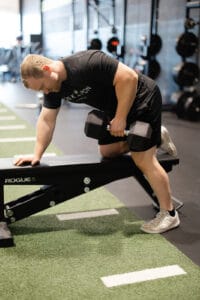
Start Light and Build Confidence
One of the biggest mistakes beginners can make is starting with weights that are too heavy. It can be tempting to grab the same weights as the person next to you, but your starting point should be based on your own strength, experience, and ability.
Coach Jonathan recommends starting with lighter weights and higher repetitions when learning a new movement. This allows you to practice good form, build tolerance, and become more comfortable with the exercise before increasing the challenge.
Coach Matt also emphasizes that understanding the movement should come before adding load:
“Our first goal is to ensure we understand the movement before adding load. Therefore, I encourage people to start light, confirm they are performing it properly first, and then gradually increase the weight to the highest point they can maintain without breaking form.”
So, how do you know if you’ve chosen the right starting weight?
Coach Janae recommends using the prescribed reps as your guide. If you can easily finish all your reps and feel like you could complete five or more additional reps, the weight may be too light. If you can’t finish your reps or have to sacrifice your form to get through them, it may be too heavy.
Ideally, you want to complete all your repetitions with good form while feeling challenged during those final few reps.
And don’t be afraid to ask a coach for guidance! You don’t need to know which weights to grab or how to perform every movement before walking into the gym. That’s what your coaches are there for.
How to Know When You’re Ready to Increase Your Weight
So how do you know when it’s time to grab the next set of dumbbells?
A good starting point is to pay attention to how your body feels throughout the exercise. If you’re completing all of your reps with proper form and the weight no longer feels challenging, you may be ready to increase it.
Our coaches often use two terms to help members understand exercise intensity: RPE (Rate of Perceived Exertion) and RIR (Reps in Reserve).
RPE is a scale of 1 to 10 that measures how difficult an exercise feels. RIR refers to how many additional repetitions you feel you could complete at the end of a set while maintaining good form. For example, 2–3 reps in reserve means you could probably complete another two or three repetitions before reaching your max.
Coach Matt explains that our workouts often aim for around an 8 on the RPE scale during strength training, while leaving approximately 2–3 reps “in the tank.”
Coach Janae offers a simple way to put this into practice:
“If you can complete all of your reps with good form, but the last few reps feel challenging, and you could only do about 2–3 more reps, you’ve probably found the right weight.”
On the other hand, if your workout calls for 8 reps, and you feel like you could easily complete 12 or more without compromising your form, it may be time to increase your load.
Before increasing your weight, here are a few questions to ask yourself:
- Can I complete all of the prescribed reps?
- Am I maintaining control and proper form throughout the movement?
- Do the final few reps feel challenging without getting sloppy?
- Am I using the intended muscles rather than relying on momentum or compensation?
If the answer is yes to most of these, you may be ready to progress!
And remember, increasing your weight isn’t something you need to figure out on your own. At Oak and Iron Fitness, you’ll see recurring movements in your programming, giving you opportunities to build familiarity and gradually increase your load as your strength and technique improve.
And also remember, you can always try a heavier weight, and if it doesn’t feel right, you can always go back down in weight.
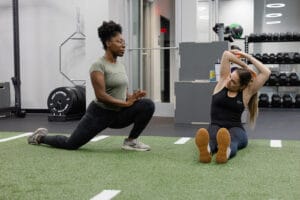
Remember: Heavier Isn’t Always Better
It’s easy to think that getting stronger only means lifting heavier weights, but increasing your weight isn’t the only way to make progress.
In fact, consistently lifting heavy without allowing your body adequate recovery can lead to unnecessary strain and overuse injuries.
Coach Jonathan reminds us that:
“Lifting heavy all the time is not advised.”
Varying exercise selection, intensity, and frequency helps manage the stress placed on your body and gives you opportunities to recover.
Coach Janae also emphasizes that the best weight depends on your goals, experience, and the exercise you’re performing.
“The goal is to challenge your muscles while maintaining proper form and control within the intended rep range.”
There are several ways to challenge your body without adding more weight. You can focus on:
- Increasing repetitions: Completing more repetitions with the same weight.
- Improving your range of motion: Working toward a fuller, more controlled movement.
- Slowing down your tempo: Taking more time during the lowering or lifting portion of an exercise.
- Increasing time under tension: Holding a position or maintaining muscle engagement for longer.
Coach Matt also notes that there comes a point where you can’t keep increasing the weight without your form eventually breaking down. That’s where other training techniques, such as tempo work and isometric holds, can help you continue progressing.
Ultimately, strength training is about challenging your body appropriately, not simply seeing how much weight you can lift.
Your Workout Should Meet You Where You Are
One of the most important things to remember about strength training is that everyone’s starting point is different.
Your mobility, strength, experience, injuries, and individual goals all play a role in determining which exercises and weights are right for you. That’s why modifications and progressions are such an important part of your fitness journey.
Coach Jen explains that modifications don’t necessarily mean removing an exercise altogether. Sometimes, a small adjustment can make a movement more accessible while still allowing you to work toward its intended purpose. This could mean decreasing the range of motion, adding stability, or adjusting your positioning.
As you become more comfortable with a movement and build strength, you can gradually work toward more challenging variations. Progressions might include adding resistance, slowing down the tempo, or increasing your range of motion.
Coach Matt puts it simply:
“A regression or modification is not a bad thing; it may just be the best way for you to get the most out of the workout on that given day.”
That’s an important reminder, especially if you’re comparing yourself to others in a class or maybe even a past version of you. Your workout doesn’t need to look exactly like someone else’s or like it did when you were 25 years old to be effective.
The goal is to find the version of each movement that allows you to work with good technique, build strength, and feel appropriately challenged.
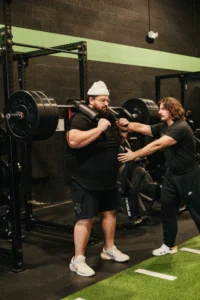
How Oak and Iron Fitness Coaches Help You Build Confidence
You don’t have to figure out strength training on your own. Having knowledgeable coaches in your corner can make a huge difference, especially when you’re learning new movements or trying to determine which weights to use.
At Oak and Iron Fitness, our coaches are there to help you understand each exercise, provide guidance on proper technique, and offer modifications or progressions based on your individual needs.
As Coach Matt explains, the programming at Oak and Iron Fitness is designed with different experience levels and abilities in mind. Coaches consider progressions and regressions so they can meet members where they are and find the most accessible version of a movement.
Whether you’re picking up weights for the first time, returning to exercise after a break, or looking to take your strength training to the next level, our goal is to help you feel confident and supported.
We believe fitness should meet you where you are. You don’t need to have experience, know all the exercises, or lift a certain amount of weight before walking through our doors. That’s what we’re here for!
Conclusion: Ready to Get Started?
Strength training is a journey, and building confidence takes time. Start with manageable weights, focus on good form, listen to your body, and remember that progress looks different for everyone.
You don’t need to lift the heaviest weights in the room to get stronger. You just need to show up, put in the work, and give yourself the opportunity to improve along the way.
If you’ve been thinking about trying a group fitness class but aren’t sure where to start, we’d love to help!
At Oak and Iron Fitness, our coaches will meet you where you are and help you build strength at your own pace. Your first class is free, so come see what we’re all about!
Ready to get started? Visit us at Oak and Iron Fitness in Cary or North Raleigh to learn more and book your first class.